Caspase 3 antibody
 (1 reference)
 (1 validation)
Quick Overview for Caspase 3 antibody (ABIN3188045)
Target
See all Caspase 3 (CASP3) AntibodiesReactivity
Host
Clonality
Conjugate
Application
Clone
-
-
Specificity
- The antibody detects endogenous Active Caspase-3 protein.
-
Characteristics
- Mouse Monoclonal to Active Caspase-3.
-
Purification
- The antibody was affinity-purified from mouse ascites by affinity-chromatography using epitope-specific immunogen.
-
Immunogen
- Recombinant Protein
-
Isotype
- IgG1
-
-
anti-Caspase 3 (CASP3) (AA 60-100) antibody
CASP3 Reactivity: Human, Mouse, Rat, Cow, Goat WB, IF (cc) Host: Rabbit Polyclonal unconjugated
anti-Caspase 3 (CASP3) (AA 67-175) antibodyCASP3 Reactivity: Human, Mouse, Rat WB, IHC, ICC, IF Host: Rabbit Polyclonal unconjugated
anti-Caspase 3 (CASP3) (AA 220-236), (C-Term) antibodyCASP3 Reactivity: Human WB, IHC, ICC Host: Rabbit Polyclonal unconjugated
anti-Caspase 3 (CASP3) (AA 11-120) antibodyCASP3 Reactivity: Human, Mouse, Rat WB, ELISA, IHC (p), FACS, IF (cc), IF (p), IHC (fro) Host: Rabbit Polyclonal unconjugated
anti-Caspase 3 (CASP3) (Internal Region) antibodyCASP3 Reactivity: Human, Mouse, Rat, Cow WB, IHC, ELISA, ICC, IF Host: Rabbit Polyclonal unconjugated
anti-Caspase 3 (CASP3) (pSer150) antibodyCASP3 Reactivity: Human, Mouse, Rat WB, IHC, ELISA, ICC, IF Host: Rabbit Polyclonal unconjugated
anti-Caspase 3 (CASP3) (cleaved) antibodyCASP3 Reactivity: Human, Mouse, Rat IHC, IF Host: Rabbit Polyclonal unconjugated
anti-Caspase 3 (CASP3) (AA 29-175) antibodyCASP3 Reactivity: Human WB, IHC Host: Rabbit Polyclonal unconjugated
anti-Caspase 3 (CASP3) (AA 29-175) antibodyCASP3 Reactivity: Human WB, IHC, IP, ICC Host: Mouse Monoclonal C3 unconjugated
anti-Caspase 3 (CASP3) (AA 60-90) antibodyCASP3 Reactivity: Human WB, IHC (p), FACS Host: Rabbit Polyclonal RB14696 unconjugated
-
-
Application Notes
- WB 1:500-1000, IHC 1:100-200
-
Restrictions
- For Research Use only
-
-
- by
- Laboratory of Neurobiology, Department of Veterinary Sciences, University of Turin
- No.
- #100061
- Date
- 08/31/2016
- Antigen
- Caspase 3 (active)
- Lot Number
- Method validated
- Western Blotting
- Positive Control
- Mouse cerebellar tissue samples at post natal day P5
- Negative Control
- Notes
- The antibody recognized both the active and non-active form of Caspase3 and worked well in the experimental conditions tested. The product is therefore indicated for the WB use.
- Primary Antibody
- Secondary Antibody
- ABIN3179097
- Full Protocol
- Mouse cerebellar tissue samples at post natal day (P) 5 were lysed in 150 µL of lysis buffer.
- Protein concentration was determined using Bradford reagen (Sigma B6916) according to the manufacturer's recommendation.
- 30 and 60µg total protein were denatured in sample buffer for 5min at 95°C and then cooled on ice.
- Proteins were separated on a denaturing homemade 15% SDS-PAGE gel at a constant voltage of 180V for 70min.
- Proteins were transferred in a transfer buffer to nitrocellulose membrane (Amersham Biosciences, RPN203D, lot 18100/66/0207) at constant amperage of 400mA for 60min.
- Blocking of the membrane with blocking solution (0.01M PBS, 0.1% tween, 2% Bovine Serum Albumin) for 1h at RT.
- Incubation with the primary antibody ABIN3179097 diluted 1:1000 in blocking solution ON at 4°C.
- 3 washes in PBS-0.1% tween for 15min at RT.
- Incubation with the anti-mouse horseradish peroxidase (HRP) secondary antibody (Santa Cruz, SC2005, lot H0406) diluted 1:10000 in blocking solution for 1h at RT.
- Washes in PBS-0.1% tween for 15min at RT.
- Chemiluminescence detection using homemade ECL (1min incubation at RT) and revealed on HYPERFILM EGL (Amersham Biosciences, RPN2013K, lot 04450300115); exposure 30sec.
- Proteins were revealed using the ECL technique on western blot films for 30 seconds.
- Experimental Notes
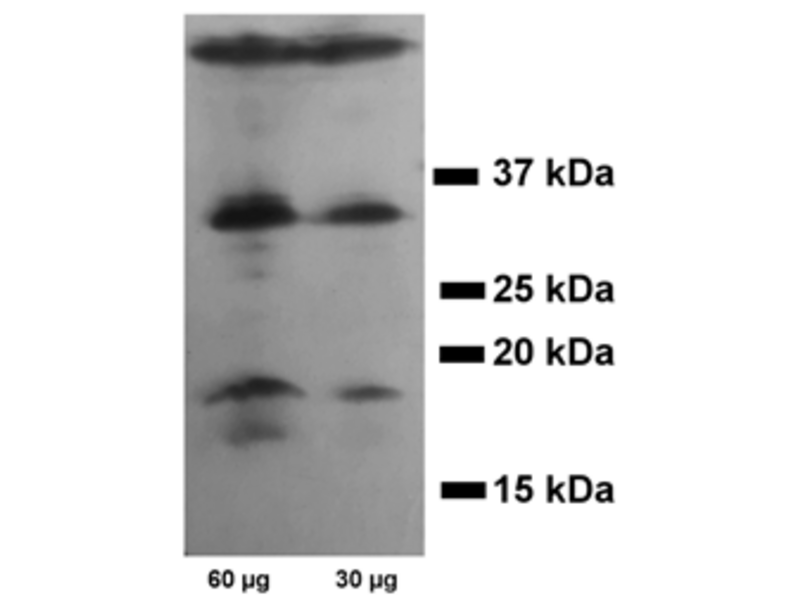
- A band around 30-35 kDa and a band around 17kDa were detected with the experimental procedures previously described.
- A protein load of 30µg is recommended, as in the 60µg load, weak non-specific bands were detected around 15 and 30kDa.
Validation #100061 (Western Blotting)
 Validation Images
![P5 mouse cerebellum, 30 seconds exposition. 60µg (left) and 30µg (right) protein loaded. The inactive procaspase 3 is visible at a MW of approximately 32kDa. The p17 subunit of active Casp3 is revealed between the 15kDa and 20kDa bands of the MW marker.]() P5 mouse cerebellum, 30 seconds exposition. 60µg (left) and 30µg (right) protein loaded. The inactive procaspase 3 is visible at a MW of approximately 32kDa. The p17 subunit of active Casp3 is revealed between the 15kDa and 20kDa bands of the MW marker.
Full Methods
P5 mouse cerebellum, 30 seconds exposition. 60µg (left) and 30µg (right) protein loaded. The inactive procaspase 3 is visible at a MW of approximately 32kDa. The p17 subunit of active Casp3 is revealed between the 15kDa and 20kDa bands of the MW marker.
Full Methods -
-
Format
- Liquid
-
Buffer
- Liquid in PBS containing 50 % glycerol, 0.5 % BSA and 0.02 % sodium azide.
-
Preservative
- Sodium azide
-
Precaution of Use
- This product contains Sodium azide: a POISONOUS AND HAZARDOUS SUBSTANCE which should be handled by trained staff only.
-
Handling Advice
- Avoid repeated freeze/thaw cycles.
-
Storage
- -20 °C
-
Storage Comment
- Store at -20°C.
-
-
-
: "Alpha-1-Antitrypsin Protects Vascular Grafts of Brain-Dead Rats Against Ischemia/Reperfusion Injury." in: The Journal of surgical research, Vol. 283, pp. 953-964, (2023) (PubMed).
-
: "Alpha-1-Antitrypsin Protects Vascular Grafts of Brain-Dead Rats Against Ischemia/Reperfusion Injury." in: The Journal of surgical research, Vol. 283, pp. 953-964, (2023) (PubMed).
-
- Caspase 3 (CASP3)
-
Alternative Name
- Caspase-3
-
Gene ID
- 836
-
UniProt
- P42574
-
Pathways
- Apoptosis, Caspase Cascade in Apoptosis, Sensory Perception of Sound, ER-Nucleus Signaling, Positive Regulation of Endopeptidase Activity, Activated T Cell Proliferation
Target
-