DLX5 antibody (Center)
 (1 validation)
Quick Overview for DLX5 antibody (Center) (ABIN5619487)
Target
See all DLX5 AntibodiesReactivity
Host
Clonality
Conjugate
Application
-
-
Binding Specificity
- Center
-
Specificity
- Recognizes endogenous levels of DLX5 protein
-
Cross-Reactivity (Details)
- Mouse, Rat, Chicken
-
Characteristics
- Purified Polyclonal DLX5 antibody
-
Purification
- DLX5 antibody was purified by immunogen affinity chromatography
-
Immunogen
- DLX5 antibody was raised in Rabbit using a KLH-conjugated synthetic peptide encompassing a sequence within the center region of human DLX5 as the immunogen
-
-
anti-Distal-Less Homeobox 5 (DLX5) (AA 191-279) antibody
DLX5 Reactivity: Human WB, ELISA, IF Host: Mouse Monoclonal 3B11 unconjugated
anti-Distal-Less Homeobox 5 (DLX5) (Internal Region) antibodyDLX5 Reactivity: Human, Mouse, Rat WB, ELISA, IHC, IF, ICC Host: Rabbit Polyclonal unconjugated
anti-Distal-Less Homeobox 5 (DLX5) (AA 1-249) antibodyDLX5 Reactivity: Human ELISA, IHC, IF Host: Rabbit Polyclonal unconjugated
anti-Distal-Less Homeobox 5 (DLX5) (AA 1-110) antibodyDLX5 Reactivity: Human ELISA, IF Host: Mouse Monoclonal 1B3 unconjugated
anti-Distal-Less Homeobox 5 (DLX5) (AA 1-110) antibodyDLX5 Reactivity: Human WB, ELISA Host: Mouse Monoclonal 4F5 unconjugated
anti-Distal-Less Homeobox 5 (DLX5) (AA 191-279) antibodyDLX5 Reactivity: Human WB, ELISA, IF Host: Mouse Monoclonal 4C6 unconjugated
anti-Distal-Less Homeobox 5 (DLX5) (AA 1-110) antibodyDLX5 Reactivity: Human ELISA, IHC (p) Host: Mouse Monoclonal 1B7 unconjugated
anti-Distal-Less Homeobox 5 (DLX5) (AA 71-120) antibodyDLX5 Reactivity: Human, Mouse, Rat, Dog, Cow, Horse, Rabbit, Pig, Bat, Hamster WB, IHC, IHC (p) Host: Rabbit Polyclonal unconjugated
anti-Distal-Less Homeobox 5 (DLX5) (Internal Region) antibodyVerified DLX5 Reactivity: Human WB, ELISA, IHC Host: Goat Polyclonal unconjugated
anti-Distal-Less Homeobox 5 (DLX5) (N-Term) antibodyDLX5 Reactivity: Human, Mouse, Rat, Dog, Cow, Horse, Rabbit, Pig, Bat, Hamster, Monkey WB, IHC, IHC (p) Host: Rabbit Polyclonal unconjugated
-
-
Application Notes
- WB: 1:500 - 1:1000, IHC: 1:100 - 1:200, IF: 1:100 - 1:500, ICC: 1:100 - 1:500, IP: 1:10 - 1:100
-
Restrictions
- For Research Use only
-
-
- by
- Gianluca Zambanini, Anna Nordin and Claudio Cantù; Cantù Lab, Gene Regulation during Development and Disease, Linköping University
- No.
- #104402
- Date
- 12/07/2022
- Antigen
- DLX5
- Lot Number
- X21080310
- Method validated
- Cleavage Under Targets and Release Using Nuclease
- Positive Control
Polyclonal rabbit anti-H3K4me (antibodies-online, ABIN3023251)
- Negative Control
Polyclonal guinea pig anti-rabbit IgG (antibodies-online, ABIN101961)
- Notes
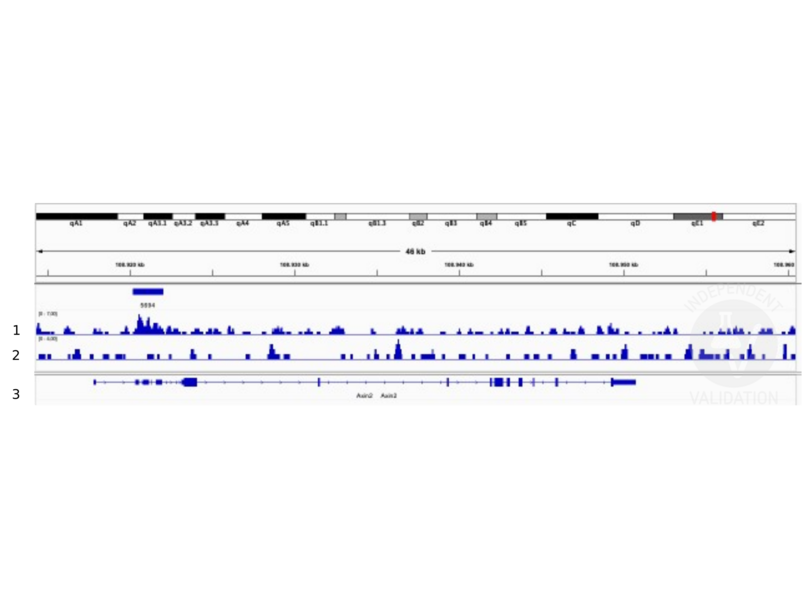
Passed. ABIN5619487 allows for CUT&RUN targeted profiling of DLX5 in mouse forelimb tissue.
- Primary Antibody
- ABIN5619487
- Secondary Antibody
- Full Protocol
- Cell harvest and nuclear extraction
- Dissect 3 Fore limbs (11.5 DAC) from mouse strain RjOrl:SWISS for each sample.
- Dissociate the tissue into single cells in TrypLE (Thermo Fisher Scientific) for 15 min at 37 °C.
- Centrifuge cell solution 5 min at 800 x g at RT.
- Remove the liquid carefully.
- Gently resuspend cells in 1 mL of Nuclear Extraction Buffer (20 mM HEPES-KOH pH 8.2, 20% Glycerol, 0.05% IGEPAL, 0.5 mM Spermidine, 10 mM KCl, Roche Complete Protease Inhibitor EDTA-free).
- Move the solution to a 2 mL centrifuge tube.
- Pellet the nuclei 800 x g for 5 min.
- Repeat the NE wash twice for a total of three washes.
- Resuspend the nuclei in 20 µL NE Buffer per sample.
- Concanavalin A beads preparation
- Prepare one 2 mL microcentrifuge tube.
- Gently resuspend the magnetic Concanavalin A Beads (antibodies-online, ABIN6952467).
- Pipette 20 µL Con A Beads slurry for each sample into the 2 mL microcentrifuge tube.
- Place the tube on a magnet stand until the fluid is clear. Remove the liquid carefully.
- Remove the microcentrifuge tube from the magnetic stand.
- Pipette 1 mL Binding Buffer (20 mM HEPES pH 7.5, 10 mM KCl, 1 mM CaCl2, 1 mM MnCl2) into the tube and resuspend ConA beads by gentle pipetting.
- Spin down the liquid from the lid with a quick pulse in a table-top centrifuge.
- Place the tubes on a magnet stand until the fluid is clear. Remove the liquid carefully.
- Remove the microcentrifuge tube from the magnetic stand.
- Repeat the wash twice for a total of three washes.
- Gently resuspend the ConA Beads in a volume of Binding Buffer corresponding to the original volume of bead slurry, i.e. 20 µL per sample.
- Nuclei immobilization – binding to Concanavalin A beads
- Carefully vortex the nuclei suspension and add 20 µL of the Con A beads in Binding Buffer to the cell suspension for each sample.
- Close tube tightly incubates 10 min at 4 °C.
- Put the 2 mL tube on the magnet stand and when the liquid is clear remove the supernatant.
- Resuspend the beads in 1 mL of EDTA Wash buffer (20 mM HEPES pH 7.5, 150 mM NaCl, 0.5 mM Spermidine, Roche Complete Protease Inhibitor EDTA-free, 2mM EDTA).
- Incubate 5 min at RT.
- Place the tube on the magnet stand and when the liquid is clear remove the supernatant.
- Resuspend the beads in 200 µl of Wash Buffer (20 mM HEPES pH 7.5, 150 mM NaCl, 0.5 mM Spermidine, Roche Complete Protease Inhibitor EDTA-free) per sample.
- Primary antibody binding
- Divide nuclei suspension into separate 200 µL PCR tubes, one for each antibody (150,000 cells per sample).
- Add 2 µL antibody (anti-DLX5 antibody ABIN5619487, anti-H3K4me positive control antibody ABIN3023251, and guinea pig anti-rabbit IgG negative control antibody ABIN101961) to the respective tube, corresponding to a 1:100 dilution.
- Incubate at 4 °C ON.
- Place the tubes on a magnet stand until the fluid is clear. Remove the liquid carefully.
- Remove the microcentrifuge tubes from the magnetic stand.
- Wash with 200 µL of Wash Buffer using a multichannel pipette to accelerate the process.
- Repeat the wash five times for a total of six washes.
- pAG-MNase Binding
- Prepare a 1.5 mL microcentrifuge tube containing 100 µL of pAG mix per sample (100 µL of wash buffer + 58.5 µg pAG-MNase per sample).
- Place the PCR tubes with the sample on a magnet stand until the fluid is clear. Remove the liquid carefully.
- Remove tubes from the magnetic stand.
- Resuspend the beads in 100 µL of pAG-MNase premix.
- Incubate 30 min at 4 °C.
- Place the tubes on a magnet stand until the fluid is clear. Remove the liquid carefully.
- Remove the microcentrifuge tubes from the magnetic stand.
- Wash with 200 µL of Wash Buffer using a multichannel pipette to accelerate the process.
- Repeat the wash five times for a total of six washes.
- Resuspend in 100 µL of Wash Buffer.
- MNase digestion and release of pAG-MNase-antibody-chromatin complexes
- Place PCR tubes on ice and allow to chill.
- Prepare a 1.5 mL microcentrifuge tube with 102 µl of 2 mM CaCl2 mix per sample (100 µl Wash Buffer + 2 µL 100 mM CaCl2) and let it chill on ice.
- Always in ice, place the samples on the magnetic rack and when the liquid is clear remove the supernatant.
- Resuspend the samples in 100 µl of the 2 mM CaCl2 mix and incubate in ice for exactly 30 min.
- Place the sample on the magnet stand and when the liquid is clear remove the supernatant.
- Resuspend the sample in 50 µl of 1x Urea STOP Buffer (8.5 M Urea, 100 mM NaCl, 2 mM EGTA, 2 mM EDTA, 0.5% IGEPAL).
- Incubate the samples 1h at 4°C.
- Transfer the supernatant containing the pAG-MNase-bound digested chromatin fragments to fresh 200 µl PCR tubes.
- DNA Clean up
- Take the Mag-Bind® TotalPure NGS beads (Omega Bio-Tek, M1378-01) from the storage and wait until they are at RT.
- Add 2x volume of beads to each sample (e.g. 100 µL of beads for 50 µL of sample).
- Incubate the beads and the sample for 15 min at RT.
- During incubation prepare fresh EtOH 80%.
- Place the PCR tubes on a magnet stand and when the liquid is clear remove the supernatant.
- Add 200 µl of fresh 80% EtOH to the sample without disturbing the beads (Important!!! Do NOT resuspend the beads or remove the tubes from the magnet stand or the sample will be lost).
- Incubate 30 sec at RT.
- Remove the EtOH from the sample.
- Repeat the wash with 80% EtOH.
- Resuspend the beads in 25 µL of 10 mM Tris-HCl pH 8.2.
- Incubate the sample for 2 min at RT.
- Repeat the 2x beads clean up as described before (this time with 50 µL of beads for each sample).
- Resuspend the beads + DNA in 20 µL of 10 mM Tris-HCl pH 8.2.
- Library preparation and sequencing
- Prepare Libraries using KAPA HyperPrep Kit using KAPA Dual-Indexed adapters according to protocol.
- Sequence samples on an Illumina NextSeq 500 sequencer, using a NextSeq 500/550 High Output Kit v2.5 (75 Cycles), 36 bp PE.
- Peak calling
- Trim reads using using bbTools bbduk (BBMap - Bushnell B. - sourceforge.net/projects/bbmap/) to remove adapters, artifacts and repeat sequences.
- Map aligned reads to the hg38 human genome using bowtie with options -m 1 -v 0 -I 0 -X 500.
- Use SAMtools to convert SAM files to BAM files and remove duplicates.
- Use BEDtools genomecov to produce Bedgraph files.
- Call peaks using SEACR with a 0.001 threshold and the option norm stringent.
- Experimental Notes
The protocol is published in Zambanini, G. et al. A New CUT&RUN Low Volume-Urea (LoV-U) protocol uncovers Wnt/β-catenin tissue-specific genomic targets. Development (2022). PMID 36355069
Validation #104402 (Cleavage Under Targets and Release Using Nuclease)
 Validation Images
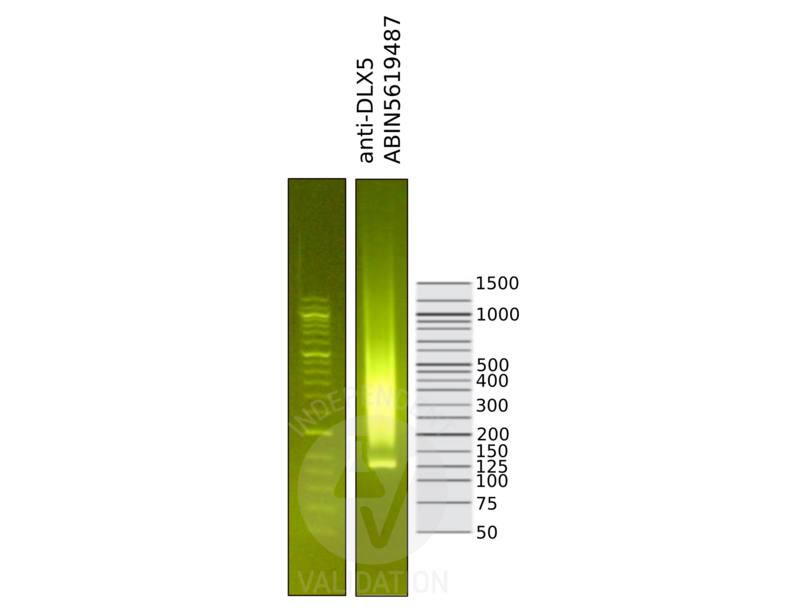
![Library profiles comparing fragment size distributions on an E-Gel EX 2% agarose gel (Thermo Fisher). Fragments obtained from CUT&RUN using anti-DLX5 antibody ABIN5619487 (right) after library preparation, compared to the E-Gel Sizing DNA Ladder (Thermo Fisher) (left).]() Library profiles comparing fragment size distributions on an E-Gel EX 2% agarose gel (Thermo Fisher). Fragments obtained from CUT&RUN using anti-DLX5 antibody ABIN5619487 (right) after library preparation, compared to the E-Gel Sizing DNA Ladder (Thermo Fisher) (left).
Library profiles comparing fragment size distributions on an E-Gel EX 2% agarose gel (Thermo Fisher). Fragments obtained from CUT&RUN using anti-DLX5 antibody ABIN5619487 (right) after library preparation, compared to the E-Gel Sizing DNA Ladder (Thermo Fisher) (left).
![1. Peaks for DLX5 called by SEACR. 2. Alignment tracks from CUT&RUN targeting DLX5 in mouse fore limb (11.5) cells using ABIN5619487, showing the Axin2 locus. 3. Alignment tracks using negative control IgG, ABIN1019613. 4. RefSeq Genes.]() 1. Peaks for DLX5 called by SEACR. 2. Alignment tracks from CUT&RUN targeting DLX5 in mouse fore limb (11.5) cells using ABIN5619487, showing the Axin2 locus. 3. Alignment tracks using negative control IgG, ABIN1019613. 4. RefSeq Genes.
Full Methods
1. Peaks for DLX5 called by SEACR. 2. Alignment tracks from CUT&RUN targeting DLX5 in mouse fore limb (11.5) cells using ABIN5619487, showing the Axin2 locus. 3. Alignment tracks using negative control IgG, ABIN1019613. 4. RefSeq Genes.
Full Methods -
-
Format
- Liquid
-
Buffer
- Supplied in liquid form in 0.42 % Potassium phosphate, 0.87 % Sodium chloride, pH 7.3 with 30 % glycerol and 0.01 % sodium azide
-
Preservative
- Sodium azide
-
Precaution of Use
- This product contains Sodium azide: a POISONOUS AND HAZARDOUS SUBSTANCE which should be handled by trained staff only.
-
Storage
- 4 °C/-20 °C
-
Storage Comment
- Store at 4 deg C for short term storage. For long term, aliquot and store at -20 deg C. Avoid repeat freeze/thaw cycles
-
-
- DLX5 (Distal-Less Homeobox 5 (DLX5))
-
Alternative Name
- DLX5
Target
-