
Antibody Validation: Knockout and Knockdown Validated Antibodies
Julian PampelReliable antibody performance is essential for reproducible life science research. An antibody may generate a strong signal while still detecting unintended proteins or producing application-dependent background. Antibody validation therefore aims to provide experimental evidence that the observed signal is associated with the intended target under defined experimental conditions.
Several complementary strategies can be used to assess antibody specificity. Among the most direct approaches are genetic validation methods, in which expression of the target is eliminated or reduced and the resulting antibody signal is compared with an appropriate control. Knockout (KO) and knockdown (KD) validation can therefore provide strong evidence that antibody detection depends on the presence of the target protein.
Antibody validation should always be interpreted in the context of the tested application, sample type and experimental conditions. Validation in one experimental system does not automatically establish performance in every other application. Learn more about different validation approaches, our in-house validation and discover our portfolio of KO & KD validated antibodies below!
Discover KO- and KD-Validated Antibodies
Genetic Antibody Validation
Genetic validation tests antibody specificity by experimentally altering expression of the gene encoding the target protein. Samples in which target expression has been eliminated or reduced are compared with samples expressing the target normally. If the antibody signal changes accordingly, this supports the conclusion that the detected signal originates from the intended target.
Two common strategies are knockout (KO), in which the target gene is disrupted, and knockdown (KD), in which target expression is reduced. Although both approaches rely on the same general principle, the expected experimental outcome and interpretation differ.
Knockout (KO) Validation
Knockout validation compares antibody detection in a target-expressing sample with a genetically matched sample in which the target gene has been disrupted. CRISPR/Cas genome editing is frequently used to generate knockout cell lines, although knockout animals and other genetically deficient models can also provide suitable controls.
In an ideal KO validation experiment, the wild-type or parental sample produces a target-specific antibody signal, whereas this signal is absent in the knockout sample. This comparison provides a genetically defined negative control and can offer strong evidence that the observed antibody signal depends on expression of the target.
For Western blot validation, for example, a band at the expected molecular weight should be detectable in the wild-type sample and disappear in the corresponding knockout lysate. The same principle can be applied to other antibody-based methods when suitable KO controls are available.
KO validation nevertheless requires appropriate interpretation. Genome editing may generate alternative or truncated protein products, and knockout cells can undergo compensatory biological changes. The experimental system should therefore confirm that the relevant target protein or antibody epitope is genuinely absent.
Browse KO-Validated Antibodies
KO-Validated Antibody Example: Synaptopodin
The Synaptopodin antibody ABIN1742348 is an example of a KO-validated antibody in our portfolio. Synaptopodin is an actin-associated protein expressed in differentiated podocytes and specific neuronal compartments, and knockout controls provide a stringent way to assess target-dependent signal detection.
In the validation experiment, signal obtained with the Synaptopodin antibody is compared between wild-type and Synaptopodin knock-out mouse brain homogenates. Loss of the specific signal in the knockout sample supports target-specific detection.
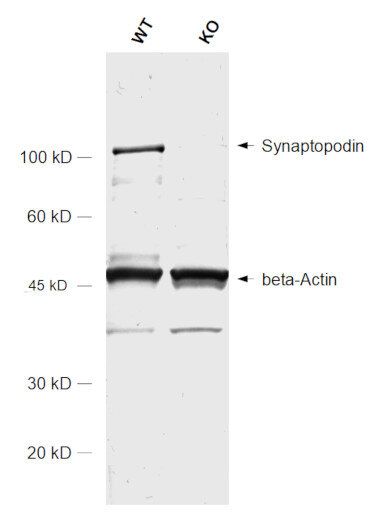
Detection of Synaptopodin and β-Actin in wild type (WT) and Synaptopodin knock-out (KO) mouse brain homogenates. 1
Knockdown (KD) Validation
Knockdown validation follows a similar principle but reduces target expression rather than eliminating it completely. Gene silencing can be achieved using approaches such as siRNA or shRNA, while other systems such as CRISPR interference can also suppress gene expression.
The antibody signal is compared between control cells and cells in which expression of the target has been reduced. A corresponding decrease in antibody signal supports the conclusion that the detected signal is associated with the intended protein.
Unlike knockout validation, a residual antibody signal is generally expected because knockdown rarely removes all target expression. The magnitude of the signal reduction should therefore be considered together with the efficiency of target depletion.
KD validation can be particularly useful when complete knockout is biologically difficult or when loss of the target substantially affects cell viability or phenotype. However, incomplete silencing and off-target effects of the knockdown procedure can make interpretation more complex than with a well-characterized knockout model.
Browse KD-Validated Antibodies
KD-Validated Antibody Example: SNAP47
The SNAP47 antibody ABIN1742240 is an example of a KD-validated antibody in our portfolio. SNAP47 is a synaptosomal-associated protein involved in vesicle trafficking, and knockdown validation helps demonstrate that antibody detection follows reduced target expression.
In the validation data, control samples are compared with SNAP47 siRNA-treated samples. Reduced immunofluorescence and Western blot signal after knockdown, together with quantitative analysis, support target-specific detection of SNAP47. Immunofluorescence and Western blot analysis show reduced SNAP47 signal after siRNA-mediated knockdown. Quantification confirms significantly decreased SNAP47 levels (P < 0.005). βIII tubulin serves as loading control.
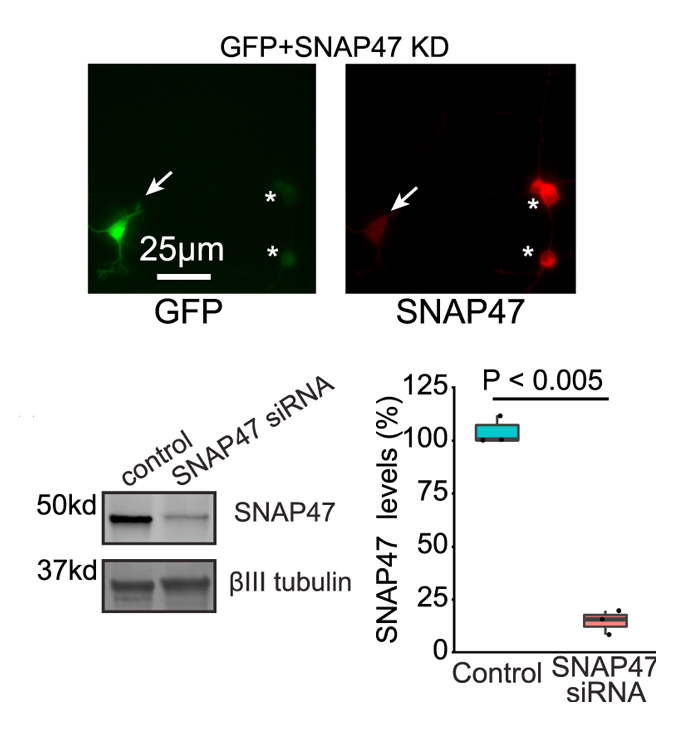
Knockdown validation of SNAP47 in control and SNAP47 siRNA-treated samples. 2
Knockout vs. Knockdown Validation
KO and KD validation use the same fundamental strategy: change expression of the target and determine whether the antibody signal follows that change. The main difference is whether target expression is eliminated or reduced.
| Characteristic | Knockout (KO) | Knockdown (KD) |
|---|---|---|
| Principle | Target gene is disrupted. | Target gene expression is reduced. |
| Common approaches | CRISPR/Cas gene editing, genetically deficient models. | siRNA, shRNA or other gene-silencing approaches. |
| Comparison | Wild-type or parental sample vs. knockout sample. | Control sample vs. knockdown sample. |
| Expected target expression | Ideally absent. | Reduced but usually still present. |
| Expected antibody signal | Target-specific signal should disappear. | Target-specific signal should decrease in accordance with target depletion. |
| Key strength | Provides a strong genetically defined negative control. | Can be used when complete target loss is impractical or biologically problematic. |
| Important consideration | Residual isoforms, truncated proteins or biological adaptation can complicate interpretation. | Incomplete knockdown and off-target effects can complicate interpretation. |
Interpreting Validation Data
KO and KD experiments provide strong evidence for antibody specificity when changes in antibody signal correspond to genetically controlled changes in target expression. However, antibody validation is not an absolute property of a reagent. Performance can depend on the application, sample preparation, species, tissue or cell type, antibody concentration and experimental conditions.
Genetic validation should therefore be considered evidence supporting antibody performance in the tested experimental context. Where possible, confidence can be increased by combining genetic validation with additional approaches such as independent antibodies, orthogonal expression data or other appropriate positive and negative controls.
Independent Validation Initiative
In addition to validation data supplied with individual products, antibodies-online established the Independent Validation Initiative (IVI) to generate independently collected experimental data for antibodies and ELISA kits.
The initiative is designed to ensure high standards of quality and reliability for antibodies. Through this program, antibodies are carefully tested by independent researchers who are recognized experts in their fields. These researchers assess the performance of the antibodies using unbiased methods, ensuring accurate and reliable results and therefore adding an orthogonal validation approach.
Discover IVI Validated AntibodiesReferences

Creative mind of antibodies-online with a keen eye for details. Proficient in the field of life-science with a passion for plant biotechnology and clinical study design. Responsible for illustrated and written content at antibodies-online as well as supervision of the antibodies-online scholarship program.
Go to author page


