
GFP Catcher - High-Affinity Single-Domain Antibodies
Written/ Edited by Julian Pampel, BScantibodies-online offers GFP catchers, the ideal tool for effective pulldown of GFP fusion proteins. Our catcher product lines are based on recombinant single-domain antibodies (sdAbs) derived from llamas or alpacas. This type of affinity molecules provide significant advantages over conventional IgG molecules. All of our products are produced in-house. They are highly specific with affinities tailored for a wide range of applications.
What are GFP Catchers?
The GFP Catcher is a ready to use affinity resin for immunoprecipitation of GFP-fusion proteins. GFP-Catchers and Catchers in general are based on a high-affinity single-domain antibody (sdAb) that is covalently immobilized on 4 % cross-linked agarose beads. The GFP-Catcher (ABIN5311508) thus features high affinity and superior capacity for GFP fusion proteins while showing negligible non-specific background (Fig.1). Due to the covalent and stable linkage of an GFP-specific sdAb to the agarose support, bound GFP fusion proteins are eluted from GFP Selector without contaminating IgG chains (* Band originating from maturation of GFP). GFP-Catchers immobilize a wide range of GFP derivatives: EGFP, mEGFP, Sirius, tSapphire, Cerulean, eCFP, mTurquoise, acGFP, Emerald, superecliptic pH luorin, paGFP, superfolder GFP, eYFP, mVenus and Citrine and most common CFP and YFP variants are being recognized. GFP-Catchers are compatible not only with physiological buffers but also with high stringency buffers. GFP-Catchers thus provide great freedom to adjust the binding and washing conditions to the experimental needs. In comparison with competitor products, our antibodies-online GFP Catcher (ABIN5311508) offers an increased binding capacity, 1 µl of packed beads is able to bin 4 μg GFP.
GFP Catcher ABIN5311508
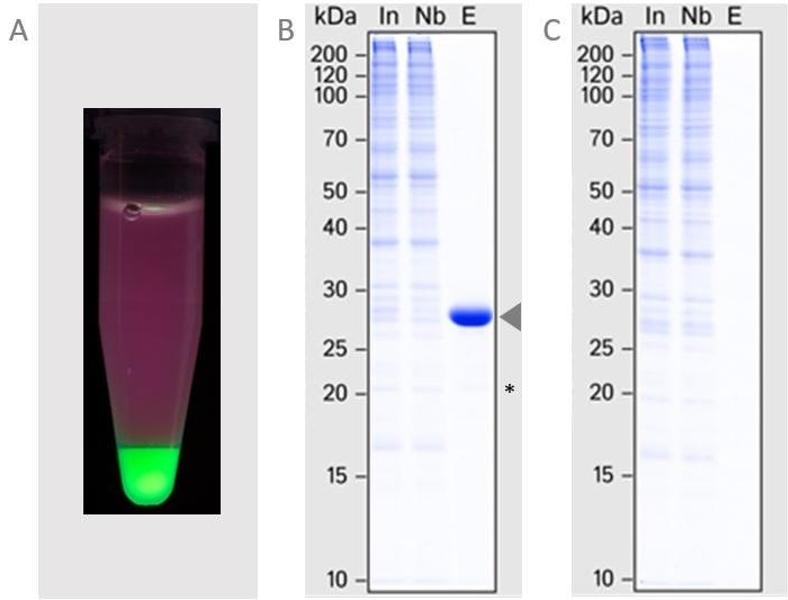
Fig.1: (A) Pull-down of GFP from a mixture of GFP, mCherry and mTagBFP (B) Immunoprecipitation of GFP (arrow) from HeLa lysate. (C) Control experiment using functionalized beads lacking sdAbs.
Advantages of Catchers for IP
- The Agarose beads of our catchers offer, in comparison with magnetic beads, the lowest background and high binding capacity for IP.
- The innovative, oriented and selective attachment via a flexible linker guarantees a high accessibility of the sdAbs and largely eliminates batch-to-batch variations.
- Due to the single-chain nature of sdAbs and their covalent attachment, no "leakage" of light and heavy chains from IgGs is observed during elution with SDS sample buffer.
- The absence of heavy & light antibody chains enables to drastically decrease the incubation time to 5-30 minutes.
- Even under harsh conditions the antibody binds with very high affinity and pulls out even low abundant proteins.
All Catchers at one glance
Need Help? Call our PhD Customer Support!
- We help you with finding the right product for your research.
- We offer Catchers as reliable replacement for Traps in IP experiments
- Contact us via email or phone: (877) 302 8632 (US) or +49 241 95 163 153 (International)
Catcher Applications
All catcher agarose beads are validated and tested for a variety of applications:
- Protein Complex Immunoprecipitation (Co-IP)
- Immunoprecipitation (IP)
- Purification (Purif)
- Chromatin Immunoprecipitation (ChIP)
- RNA-Binding Protein Immunoprecipitation (RIP)
Additive Products
Catcher-Control is a control resin for all Catcher resins, which are based on 4 % cross-linked agarose beads. It was prepared using the same activation and quenching chemistry that was used for preparation of Catcher resins, but is not charged with any single-domain antibody. Catcher-Control is thus the ideal resin for pre-depletion of extracts or as a side-by-side specificity control for any Catcher resins. When using as a specificity control, Catcher-Control and the corresponding sdAb-charged Catcher Resin should be used under identical experimental conditions.
Protocols

Creative mind of antibodies-online with a keen eye for details. Proficient in the field of life-science with a passion for plant biotechnology and clinical study design. Responsible for illustrated and written content at antibodies-online as well as supervision of the antibodies-online scholarship program.
Go to author page


